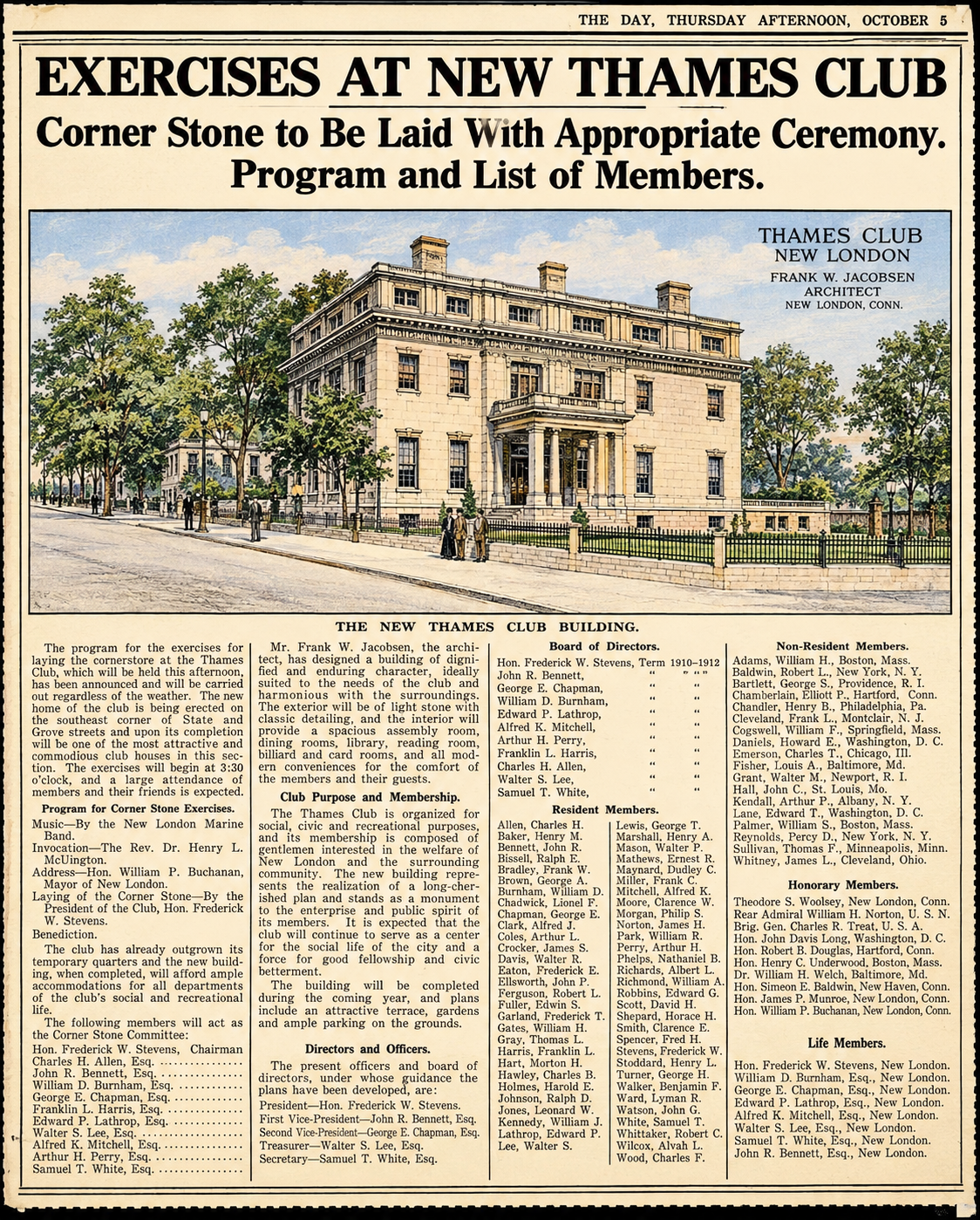
Early Club Members
People who helped shape New London
A club’s history is more than the story of its buildings. It also lives in the people who gathered there: the businesses they built, the offices they held, the performances they gave, and the experiences they brought into conversation.
In the decades surrounding the turn of the twentieth century, the Thames Club counted among its members men whose careers reached from New London’s working waterfront to the American stage and the United States Senate. Some exercised national influence. Others helped sustain the industries and public institutions on which the city depended.
Their lives offer a portrait of New London during a period when maritime enterprise, manufacturing, politics, and the arts intersected in a relatively small community.
The Chappells: Tugs, Coal, and the Working Waterfront
The Chappell family provides one of the strongest connections between the Thames Club and the maritime economy of its home city.
Frank H. Chappell, a charter member of the Club, served as president of the Thames Tow Boat Company from 1879 until his death in 1919. His four decades of leadership spanned substantial changes in shipping and waterfront industry. Tugs supplied the practical muscle of a working port, assisting vessels and moving barges and other craft through regional waters.
Alfred Hebard Chappell (1849–1912), also a Club member, was associated with the family’s coal business. In an age of steam, coal linked the waterfront with factories, transportation, and household heating. Fuel supply and towing were complementary businesses, embedded in the daily operation of the city.
The family’s maritime leadership continued with Laurence A. Chappell, who succeeded his father as president in 1919. His interests extended into banking, while his connection with the Thames Club deepened through service as its president and recognition as a life member.
The Chappells’ significance could be seen along the river: in the movement of vessels, the delivery of fuel, and the work of the shipyard. Their story places the Club firmly within the history of a city that earned its living from the water. [1, 2]
James O’Neill: A Famous Actor Among Friends
James O’Neill brought the world of professional theatre into the Club’s rooms. His membership also provides a direct connection with the family whose life in New London became part of American literary history.
Biographers Arthur and Barbara Gelb describe James visiting the Club two or three times a week during the summer, sometimes accompanied by an actor friend. The bartender remembered his preference for bourbon and milk, his courtly manner, and his generosity in buying drinks for fellow members.
His customary toast supplies a particularly vivid glimpse of the man:
“Sunny days and starry nights.”
The accounts also place his membership within the social boundaries of the period. James was among the relatively few Irishmen admitted to the Club—a reminder that the social world these men inhabited had exclusions as well as friendships. [3]
The O’Neill connection reaches beyond James’s membership. The New London walking-tour guide to Eugene O’Neill’s life identifies the Thames Club with the social world evoked in Long Day’s Journey into Night. It also suggests a possible, more affectionate echo in the fictional Sachem Club of Ah, Wilderness!
Eugene’s place in this story is as James’s son and as the writer who transformed the family’s experiences and surroundings into drama; his own Club membership has not been established in the sources consulted. [4]
Richard Mansfield: Another Link to the American Stage
James O’Neill was not the Club’s only distinguished theatrical member. The Gelbs also identify Richard Mansfield (1857–1907) as a member, giving the Club another connection to the national stage.
Mansfield was a prominent actor of the late nineteenth century whose repertoire included Dr. Jekyll and Mr. Hyde, Cyrano de Bergerac, and Beau Brummell. The last of these was written for him by playwright Clyde Fitch. His surviving family papers at the New York Public Library document a career that encompassed both musical and dramatic performance.
Including Mansfield alongside O’Neill broadens our understanding of the Club’s early character. Its membership encompassed performers whose reputations depended on audiences far beyond Connecticut, as well as men whose influence rested in local commerce and government. [3, 5]
Frank Bosworth Brandegee: From New London to the Senate
Frank Bosworth Brandegee connected the Club with national political life.
Born in New London in 1864, Brandegee graduated from Yale and entered the legal profession. He practiced with Brandegee, Noyes & Brennan and served for many years as the city’s corporation counsel.
His political career advanced from the Connecticut legislature to Washington. He became Speaker of the Connecticut House of Representatives in 1899, entered Congress in 1902, and was elected to the United States Senate in May 1905.
A contemporary biographical directory explicitly records his Thames Club membership. His career illustrates how closely local professional life could connect with national affairs: the lawyer familiar to fellow members in New London was also a participant in the country’s legislative business. [6]
Elisha L. Palmer: War, Captivity, and Industry
The life of Elisha L. Palmer carried a different kind of distinction. Behind his standing as a manufacturer lay the experience of military service and wartime imprisonment.
Born in Montville in 1840, Palmer began his career as a clerk in New York. During the Civil War, he served in the Union Army, rising from private to lieutenant. He endured captivity at Libby Prison in Richmond and at Columbia and Charleston, South Carolina.
After the war, Palmer and his brother Edward established a commission business in New York. Elisha subsequently returned to Montville and joined Palmer Brothers’ large-scale manufacture of bed quilts. When the company incorporated in 1900, he became its vice-president.
Men of Mark in Connecticut explicitly lists his Thames Club membership. His biography adds a personal dimension to the industrial history of the region: a young man returned from war and imprisonment to help build a substantial civilian enterprise. [7]
George Asahel Hammond: Manufacturing and Public Office
George Asahel Hammond exemplified the overlap between industrial leadership and public service.
A Civil War veteran, Hammond developed interests in silk manufacturing and other enterprises. These included the New London Wash Silk Company, along with businesses in machinery and manufacturing. He also served as president of Putnam Light and Power.
His public career included several terms in the Connecticut House of Representatives. Elected to the state Senate in 1910, he chaired its finance committee.
His 1911 biography identifies him as a Thames Club member. Hammond’s connections extended beyond New London into the wider economy of eastern Connecticut. His career shows how the same individual could participate in the management of businesses, the development of infrastructure, and the financial deliberations of state government. [8]
Isaac C. Tate: An Earlier Industrial Generation
Isaac C. Tate, who died in 1894, takes the story back into the Club’s nineteenth-century years.
Tate was president of the New London Horse Shoe Nail Company, established in 1859. According to Mystic Seaport Museum’s account of his family papers, the business reached its peak during the Civil War and closed in 1879.
His activities extended into investments in land and railroads, the management of family affairs, and service as a school district supervisor. The museum’s archival biography specifically identifies him as an active member of the Thames Club.
Tate represents the less familiar industrial history behind New London’s maritime identity. His surviving papers—business transactions, correspondence, and accounts—also offer a route to understanding the everyday financial and family responsibilities of an early member. [9]
Sidney Ashbey Brown: The Business of Government
Sidney Ashbey Brown built his career in public administration and law enforcement.
Born in Mystic in 1858, he worked in the county jail system before becoming a deputy federal internal revenue collector and then New London’s tax collector. In February 1905, he was appointed high sheriff of New London County to fill a vacancy. Repeated election victories kept him in office through the publication of his 1921 biography.
That biography also confirms his Thames Club membership. Brown’s place in the story is a reminder that local influence included responsibility for the daily operation of government, alongside the more visible achievements of politicians, manufacturers, and performers. [10]
John Phelps Taylor Armstrong: The Next Generation
John Phelps Taylor Armstrong entered business as the new century began. After graduating from Yale in 1904, he joined Brainerd & Armstrong as a clerk. By 1921, he had become its general manager, secretary, and director. He also held a directorship at New London’s National Bank of Commerce.
His biography records Thames Club membership by 1921. His career carried forward a familiar pattern: responsibility for manufacturing combined with participation in the city’s financial institutions. [10]
A Club Within the Life of a City
These biographies reveal a gathering place connected to many aspects of New London’s life. The Chappells brought the working waterfront; O’Neill and Mansfield, the theatre; Brandegee, national politics. Palmer, Hammond, Tate, Brown, and Armstrong contributed experience in industry, military service, finance, and government.
Their overlapping responsibilities help explain the Club’s historical interest. Members belonged to networks of businesses, public institutions, and personal relationships that extended across the city and beyond it. The evidence does not establish which decisions were made over a Club meal or conversation. It does establish that men entrusted with consequential decisions shared this institution.
Remembering them restores people to the Club’s history: a former prisoner of war, an actor offering a familiar toast, a tugboat company president, a sheriff, and a senator. Through their lives, the story of the Thames Club becomes part of the larger story of New London.
Sources & further reading
- History of Connecticut, Volume III, biography of Laurence A. Chappell — Frank and Laurence Chappell’s business and Club roles.
- Isham Genealogy: A Brief History of Jirah Isham and His Descendants — Alfred Hebard Chappell and the family history.
- Arthur and Barbara Gelb, O’Neill — James O’Neill’s Club life and Richard Mansfield’s membership.
- Touring Eugene O’Neill’s New London: Thames Club — family and literary connections.
- New York Public Library: Richard Mansfield Family Papers — theatrical career.
- District of Columbia: Concise Biographies of Its Prominent and Representative Contemporary Citizens, p. 51 — Frank Bosworth Brandegee.
- Men of Mark in Connecticut, Volume II, p. 143 — Elisha L. Palmer.
- Genealogical and Family History of the State of Connecticut, Volume IV (1911) — George Asahel Hammond.
- Mystic Seaport Museum: Tate Family Collection — Isaac C. Tate.
- A Modern History of New London County, Connecticut, Volume III — Sidney Ashbey Brown and John Phelps Taylor Armstrong.